
Batteries power everything from electric vehicles to renewable energy storage. But how do we ensure they work safely and efficiently? That’s where a Battery Management System (BMS) comes in.
A BMS monitors voltage, current, and temperature, preventing issues like overcharging and overheating. Without proper testing, a faulty BMS can lead to safety risks, reduced performance, or even battery failure.
In this guide, we’ll explore the importance of BMS testing, key procedures, and how it ensures battery reliability. Whether you’re an engineer or a tech enthusiast, this complete guide will help you understand BMS testing from start to finish.
What is Battery Management Systems
A Battery Management System (BMS) is an essential electronic system that monitors and controls rechargeable batteries. It ensures safe operation, extends battery life, and optimizes performance. Without a BMS, batteries risk overheating, overcharging, or rapid degradation.
Key functions of BMS
- Monitoring battery parameters
- Voltage: The BMS closely monitors the voltage of individual cells and the overall battery pack. It ensures that the voltage remains within safe limits.
- Current: It tracks the flow of current during charging and discharging, preventing excessive currents that could harm the battery.
- Temperature: The BMS keeps a check on the battery’s temperature to prevent overheating, which can lead to degradation or even fire.
- Controlling charging and discharging
- The BMS regulates the charging process to prevent overcharging and ensures that the battery is charged efficiently.
- It also controls the discharging process, preventing over-discharging, which can cause irreversible damage to the battery cells.
- Balancing cell voltages
- In multi-cell battery packs, the BMS ensures that all cells are balanced and maintain equal voltage levels.
- Cell balancing is crucial for maintaining the overall health and performance of the battery pack.
- Protecting against hazardous conditions
- The BMS implements various safety features to protect the battery from hazardous conditions.
- It can detect and prevent short circuits, overcurrent, and overvoltage situations.
- In case of any abnormalities, the BMS can trigger safety measures, such as disconnecting the battery or limiting its operation.
Importance of BMS in various applications
- Portable devices
- In smartphones, laptops, and other portable electronics, the BMS ensures safe and efficient battery usage.
- It helps to prevent overcharging, prolongs battery life, and provides accurate battery level information to the user.
- Electric vehicles (EVs)
- BMSs are critical components in EVs, where large battery packs power the vehicle.
- They monitor and manage the battery’s performance, ensuring optimal driving range and charging efficiency.
- The BMS also plays a crucial role in maintaining the safety of the high-voltage battery system.
- Energy storage systems
- In renewable energy systems, such as solar or wind power plants, BMSs are used to manage large-scale battery storage.
- They optimize the charging and discharging cycles, ensure efficient energy utilization, and protect the batteries from damage.
BMS Testing Procedures
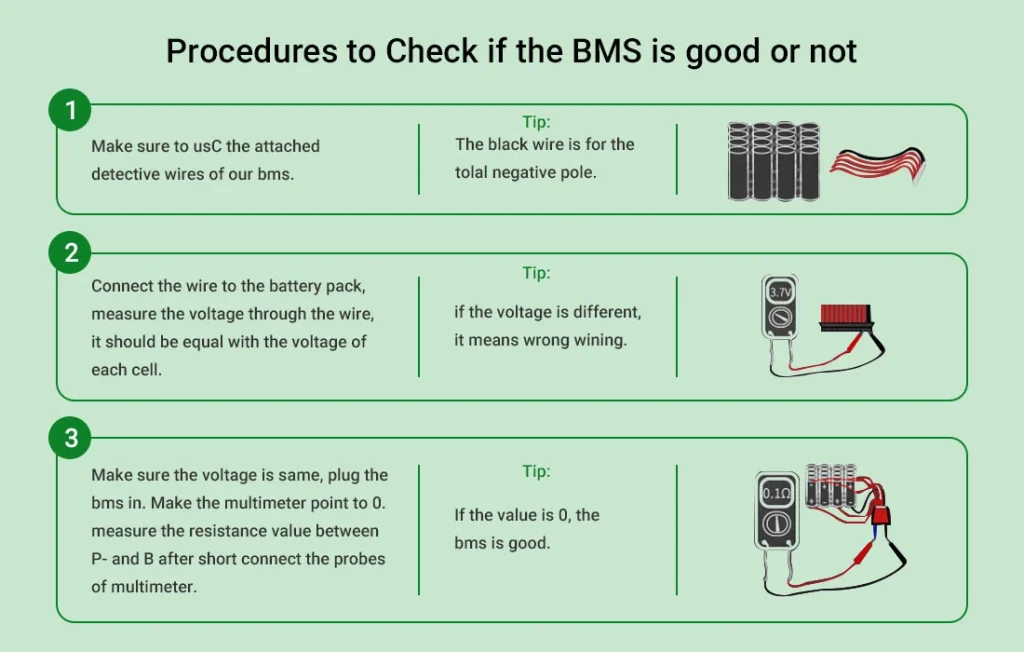
Battery Management System (BMS) testing ensures batteries operate safely, efficiently, and reliably. Engineers perform various tests to assess safety, performance, communication, and durability.
Safety Testing
A BMS protects batteries from hazardous conditions. Safety tests confirm its ability to detect and prevent failures.
- Overcharge protection testing: Ensures the system stops charging when voltage exceeds safe levels.
- Over-discharge protection testing: Prevents excessive discharge that could damage battery cells.
- Insulation resistance testing: Checks for electrical leakage between battery components.
- Short circuit and thermal runaway prevention: Evaluates how the system handles extreme conditions to avoid overheating or fires.
Example: A thermal runaway test simulates overheating to verify if the BMS cuts off power before a fire starts.
Performance Testing
A well-designed BMS must deliver stable performance over time. These tests evaluate efficiency and reliability.
- Voltage, current, and temperature accuracy: Ensures precise monitoring of critical battery parameters.
- Load response testing: Examines how the BMS manages sudden increases in power demand.
- Long-term stability: Measures performance degradation over extended use.
| Parameter | Acceptable Deviation |
|---|---|
| Voltage | ±0.5% |
| Current | ±1% |
| Temperature | ±2°C |
Communication Testing
BMS must interact with other components seamlessly. Engineers test data transmission and fault detection in communication links.
- Protocol verification: Ensures compatibility with CAN, LIN, SPI, and UART.
- Data reliability: Checks for errors in transmitting voltage, SOC, and temperature readings.
- Response time analysis: Measures how quickly the system reacts to changes.
Example: In electric vehicles, a delay in communication between the BMS and motor controller could lead to power fluctuations.
Functional Testing
Functional tests verify that a BMS performs core operations effectively under different scenarios.
- SOC estimation accuracy: Determines if the system calculates the battery’s charge level correctly.
- Cell balancing effectiveness: Evaluates how well the BMS equalizes charge across all battery cells.
- Fault detection and automated response: Assesses how the system reacts to abnormalities.
Durability Testing
Durability tests expose the BMS to real-world conditions, ensuring long-term reliability.
- Environmental stress tests: Subjects the system to extreme temperatures, humidity, and vibrations.
- Battery degradation simulations: Analyzes how the BMS manages aging cells.
- Long-term reliability: Confirms performance remains stable over thousands of charge cycles.
| Test Condition | Expected Outcome |
|---|---|
| -20°C to 60°C | No performance loss |
| 90% humidity | No short circuits |
| 100,000 charge cycles | Minimal efficiency drop |
BMS Test Methods and Tools
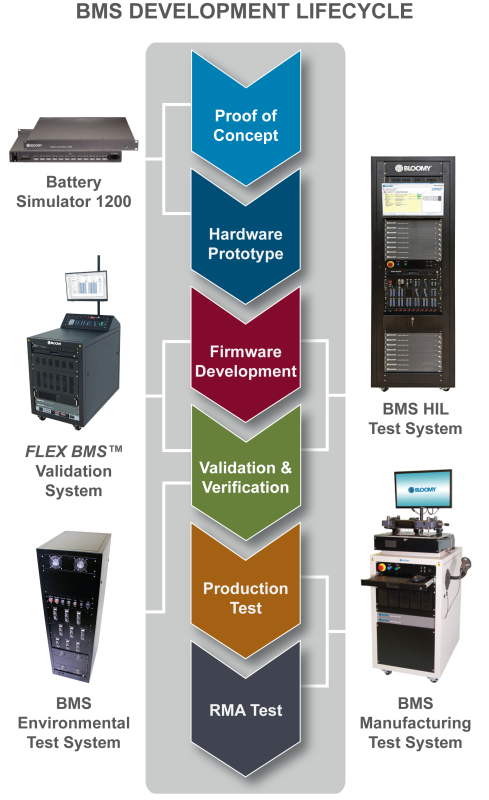
Battery Management System (BMS) testing requires reliable and accurate methods and tools to ensure the system’s performance, safety, and reliability. Choosing the right approach and equipment is crucial for conducting effective BMS tests.
Traditional BMS Test Methods and Limitations
Traditionally, BMS testing involved using a combination of real batteries, power supplies, and digital multimeters. These methods, while useful, have several limitations:
- Lack of consistency: Testing with real batteries can lead to inconsistent results due to variations in battery characteristics and performance over time.
- Limited control: Traditional methods offer limited control over the test conditions, making it difficult to simulate specific scenarios or extreme conditions.
- Safety concerns: Testing with real batteries can pose safety risks, especially when pushing the limits of the battery’s operating range.
- Time-consuming setup: Configuring the test setup with real batteries, power supplies, and multimeters can be time-consuming and prone to errors.
Advantages of Dedicated BMS Test Equipment
To overcome the limitations of traditional methods, dedicated BMS test equipment has been developed. These specialized tools offer several advantages:
- Consistency and repeatability: Dedicated BMS test equipment provides consistent and repeatable test conditions, ensuring reliable results across multiple test runs.
- Precise control: They offer precise control over voltage, current, and other parameters, allowing for the simulation of various operating conditions and scenarios.
- Enhanced safety: BMS test equipment incorporates safety features and protections, reducing the risks associated with testing under extreme conditions.
- Simplified setup: Dedicated test equipment often comes with integrated solutions, simplifying the test setup and reducing the chances of errors.
Example: HIOKI Battery Cell Voltage Generator SS7081-50
One notable example of dedicated BMS test equipment is the HIOKI Battery Cell Voltage Generator SS7081-50. It offers several key features and benefits:
- Integrated solution: The SS7081-50 combines a DC power supply, electronic load, and digital multimeter (DMM) in a single unit, providing a comprehensive testing solution.
- High precision: It delivers industry-leading voltage output precision and measurement accuracy, ensuring reliable and accurate test results.
- Safety features: The equipment incorporates safety features such as overload protection and emergency stop functions, enhancing the safety of the testing process.
- Simulation functions: The SS7081-50 offers simulation functions, allowing for the emulation of various battery cell conditions and behaviors.
- PC application: It comes with a PC application for control and simulation, enabling easy setup, monitoring, and automation of the testing process.
- Calibration and reliability: The equipment is calibrated to international standards, ensuring the reliability and traceability of the test results.
Importance of Advanced BMS Test Solutions
As battery technologies continue to advance and the demand for high-performance battery systems grows, the importance of advanced BMS test solutions becomes more evident:
- Meeting stringent quality requirements: Advanced BMS test equipment enables manufacturers to meet the increasingly stringent quality requirements of industries such as automotive, aerospace, and energy storage.
- Ensuring reliability and safety: Thorough testing with advanced equipment helps identify and address potential issues, ensuring the reliability and safety of the BMS in real-world applications.
- Accelerating development cycles: Dedicated BMS test solutions streamline the testing process, reducing development time and accelerating time-to-market for new battery systems.
- Adapting to evolving battery technologies: As battery technologies evolve, advanced BMS test equipment can adapt and accommodate new testing requirements, future-proofing the testing process.
Commercial BMS Testing Solutions
Battery Management System (BMS) testing requires advanced tools to ensure precision, efficiency, and safety. Several companies provide specialized BMS test systems, offering real-time monitoring, simulation, and validation features.
Keysight SL1700A Scienlab Battery Test System
The Keysight SL1700A is a high-performance BMS test system designed for large-scale battery pack validation.
- Real battery environment emulation: Simulates voltage, current, and temperature changes in battery cells.
- High-voltage SiC technology: Improves energy efficiency and enhances power recovery.
- Automated testing: Enables continuous validation of battery parameters.
- Scalable for high-power applications: Supports multiple configurations for electric vehicles (EVs) and industrial energy storage.
Example: The SL1700A allows engineers to replicate complex charging and discharging cycles without using real batteries.
Rohde & Schwarz BMS Testing Solutions
Rohde & Schwarz offers flexible BMS testing solutions designed for real-time monitoring and large-scale cell simulations.
- Continuous monitoring: Tracks voltage, current, and SOC in real time.
- Scalable architecture: Supports multiple battery cells, making it ideal for testing large battery packs.
- Advanced data analysis: Detects abnormalities in communication and performance.
- Protocol verification: Ensures compliance with CAN, LIN, and SPI communication standards.
Example: This system helps automotive engineers test EV battery packs, ensuring they perform under extreme conditions.
Pickering Interfaces LTD
Pickering Interfaces specializes in modular battery simulation, providing high-precision BMS test tools.
- 6-channel battery simulator: Each channel supplies up to 7V and 300mA, ideal for multi-cell testing.
- Targeted applications: Used in EVs, aerospace, and energy storage industries.
- Stackable design: Allows series connection to simulate high-voltage battery stacks.
- High-voltage isolation: Protects against power fluctuations in large-scale tests.
| Feature | Benefit |
|---|---|
| 6-channel configuration | Simulates multiple battery cells in one setup. |
| Isolated channels | Prevents cross-talk between simulated cells. |
| Supports up to 1kV stacks | Enables high-voltage testing for vehicle propulsion. |
Example: Engineers use Pickering battery simulators to test BMS balancing features in high-voltage applications.
Why Use Commercial BMS Test Solutions?
Modern battery systems require advanced testing tools for accuracy and reliability. Solutions from Keysight, Rohde & Schwarz, and Pickering offer:
- Precise battery emulation: Reduces reliance on real cells.
- Scalable testing: Supports everything from small modules to EV battery packs.
- Enhanced safety: Prevents risks like overcharging and short circuits.
Future of BMS Testing
Battery Management System (BMS) testing is evolving as electric vehicles (EVs) and renewable energy storage demand higher efficiency, reliability, and safety. Innovations in simulation, automation, and AI are shaping the next generation of BMS testing.
Growing Demand Driven by EVs and Renewable Energy
The rapid expansion of electric vehicles (EVs) and renewable energy systems is driving a significant increase in the demand for reliable and efficient battery systems. Consequently, the need for comprehensive BMS testing is on the rise.
- EVs rely heavily on high-performance battery packs, necessitating robust BMS testing to ensure safety, reliability, and optimal performance.
- The integration of renewable energy sources, such as solar and wind power, requires large-scale energy storage systems. Effective BMS testing is crucial to guarantee the stability and longevity of these battery-based systems.
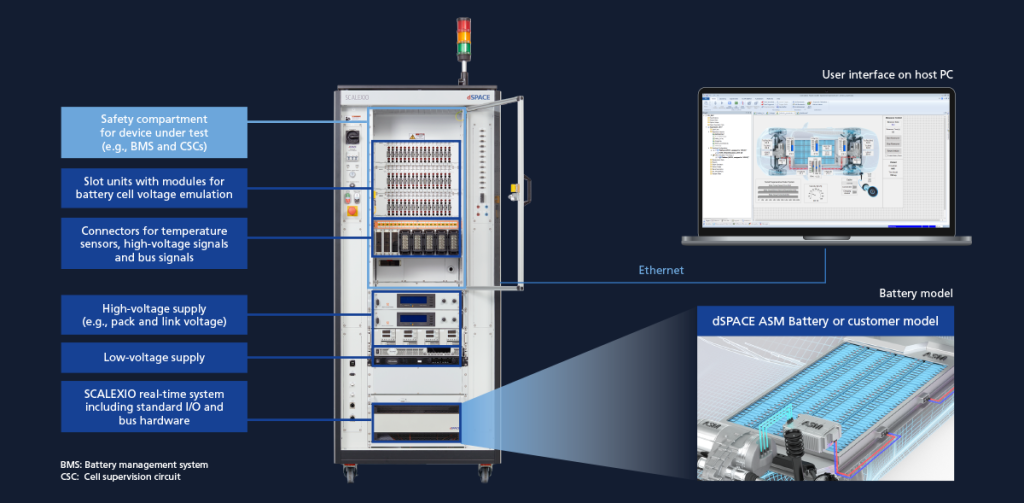
Shift from Physical Testing to HIL Simulation
Traditionally, BMS testing involved physical testing with real batteries. However, the future of BMS testing is moving towards Hardware-in-the-Loop (HIL) simulation. HIL testing offers several advantages:
- Reduced Costs: HIL simulation eliminates the need for expensive physical prototypes and battery packs, reducing overall testing costs.
- Increased Safety: By simulating battery behavior in a virtual environment, HIL testing minimizes the risks associated with physical testing, especially under extreme conditions.
- Faster Development Cycles: HIL simulation allows for rapid iterations and modifications, accelerating the development and validation process of BMS.
- Reproducibility and Consistency: HIL testing ensures reproducible and consistent test scenarios, enabling better comparison and analysis of BMS performance.
Advancements in Emulation Tools
The future of BMS testing will witness significant advancements in emulation tools, enhancing the accuracy and efficiency of the testing process.
- High-Precision Emulators: Next-generation BMS test equipment will offer higher precision in voltage, current, and temperature emulation, providing more realistic and accurate representations of battery behavior.
- Scalability and Flexibility: Emulation tools will be designed to accommodate various battery configurations and scales, from single cells to large battery packs, enabling comprehensive testing scenarios.
- Real-Time Simulation: Advanced emulation tools will leverage real-time simulation capabilities, allowing for the testing of BMS under dynamic and transient conditions, closely mimicking real-world applications.
AI-Driven Diagnostics and Predictive Maintenance
Artificial Intelligence (AI) and Machine Learning (ML) techniques will play a significant role in the future of BMS testing and diagnostics.
- Intelligent Fault Detection: AI algorithms will be employed to analyze BMS data, identifying patterns and anomalies indicative of potential faults or performance issues. This will enable proactive identification and resolution of problems.
- Predictive Maintenance: By leveraging historical data and AI-powered predictive models, BMS testing will shift towards predictive maintenance approaches. It will allow for the anticipation of battery degradation and the scheduling of maintenance activities, optimizing battery life and reducing downtime.
- Continuous Learning and Optimization: AI systems will continuously learn from the vast amounts of data generated during BMS testing, refining their models and algorithms over time. This will lead to improved accuracy, efficiency, and adaptability of BMS testing processes.
Conclusion
BMS testing is essential for battery reliability, safety, and efficiency. It prevents failures, extends lifespan, and ensures compliance with industry standards.
Comprehensive testing validates performance, communication, and fault detection. Safety tests protect against overcharging, short circuits, and overheating. Advanced tools improve accuracy and efficiency.
As battery technology evolves, test methods must adapt. HIL simulation, AI-driven diagnostics, and predictive maintenance enhance modern BMS testing.
Tertron provides battery production and testing equipment for EVs and energy storage. Their machines support assembly, grading, aging, and quality control. With automated solutions, they improve efficiency and safety in lithium-ion battery manufacturing.
FAQs
What is the purpose of BMS testing?
BMS testing ensures battery safety, efficiency, and longevity. It validates voltage regulation, current control, temperature monitoring, and fault detection. Rigorous testing prevents overcharging, overheating, and short circuits, reducing failure risks.
How often should BMS testing be performed?
Testing frequency depends on application and usage. EVs and industrial systems require regular testing, typically every few months. Critical applications may need continuous monitoring using automated test setups.
What are the most critical aspects to test in a BMS?
Key aspects include:
- Safety features: Overcharge, over-discharge, and short-circuit protection.
- Performance metrics: Voltage, current, and SOC accuracy.
- Communication protocols: CAN, LIN, and SPI verification.
- Durability tests: Environmental stress and aging simulations.
Can BMS testing prevent battery failures and safety hazards?
Yes. Early fault detection reduces failures and prevents hazards like thermal runaway. Testing identifies weak cells, ensuring optimal performance and longer battery life.
How do I choose the right BMS test equipment for my application?
Consider:
- Testing scope: Single-cell vs. full-pack testing.
- Accuracy needs: High-precision voltage and current measurement.
- Automation level: Manual vs. automated testing.
- Scalability: Support for different battery chemistries and sizes.