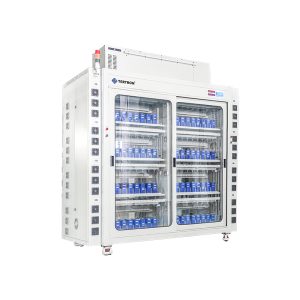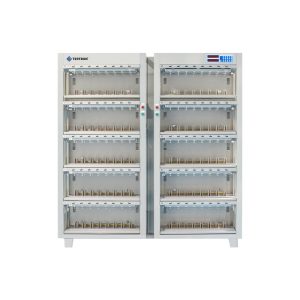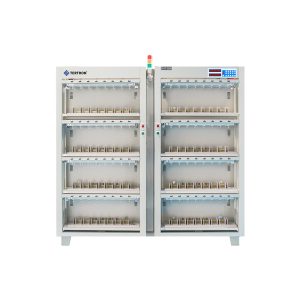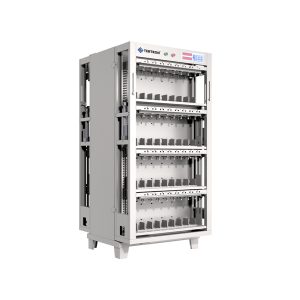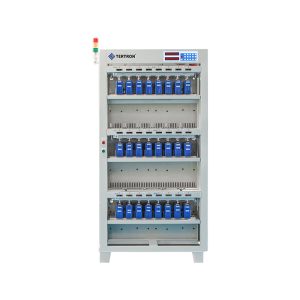

Battery Pack Aging Machine
Reliable Battery Pack Aging Machine Supplier
Tertron is an excellent and renowned Battery Pack Aging Machine manufacturer based in China. We possess state-of-the-art equipment and utilize premium components to produce our superior Battery Aging Machine. You can obtain the most reliable and efficient Battery Aging Machine from Tertron. Get in touch with us now to learn more about our cutting-edge technology and how it can benefit your business!

Supply Turnkey Project service

24/7 after-sales support, prompt issue resolution

Provide complete solutions and customized services

High quality pre-sales and after-sales service
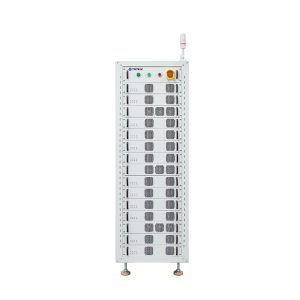
Customizable Multi-application Battery Aging Machines
Tertron offers a range of advanced battery aging solutions, including Battery Aging Cabinets and battery aging testers. These devices are designed to accurately assess the performance and longevity of lithium batteries through comprehensive charging and discharging cycles. Our equipment enables users to set specific testing parameters, such as charge and discharge protection voltages, capacity, and step sequences. Tertron’s battery aging systems provide reliable results, ensuring the quality and safety of batteries for various applications.
PRODUCT CATRGORY
contact us
all products
Specifications Of Battery Aging Machines
| Model | Chanel Number | Communication Mode | Charging Energy Saving Efficiency | Charging Voltage | Port Discharge Voltage | Charging Current | Discharge Current | Discharge Feedback Efficiency | Current/Voltage Accuracy | Recording Time | Total Power |
| 6V300A-16CH | 128 chanels | TCP/IP (network port) | 80% | 0~100V | 7.5~100V | 0A~300A | 0A~300A | 70% | ±(0.05%RD + 0.05%FS) | 100mS~65535S | 96KW |
| 60V30A-24CH | 192 chanels | TCP/IP (network port) | 90% | 0~60V | 7.5~60V | 0.1A~30A | 0.2A~30A | 88% | ±(0.1%RD + 0.1%FS) | 100mS~65535S | 54KW |
| 60V30A-32CH | 256 chanels | TCP/IP (network port) | 90% | 0~60V | 7.5~60V | 0.03A~30A | 0.1A~30A | 88% | ±(0.1%RD + 0.1%FS) | 100mS~65535S | 64KW |
| 60V60A-16CH | 128 chanels | TCP/IP (network port) | 90% | 0~60V | 7.5~60V | 0.1A~60A | 0.2A~60A | 88% | ±(0.1%RD + 0.1%FS) | 100mS~65535S | |
| 60V100A-8CH | 64 chanels | TCP/IP (network port) | 90% | 0~60V | 7.5~60V | 0.2A~100A | 0.5A~100A | 88% | ±(0.1%RD + 0.1%FS) | 100mS~65535S | |
| 60V200A-4CH | 32 chanels | TCP/IP (network port) | 90% | 0~60V | 7.5~60V | 0.2A~200A | 0.5A~200A | 88% | ±(0.1%RD + 0.1%FS) | 100mS~65535S | |
| 75V30A-24CH | 192 chanels | TCP/IP (network port) | 90% | 0~75V | 7.5~75V | 0.1A~30A | 0.2A~30A | 88% | ±(0.1%RD + 0.1%FS) | 100mS~65535S | 64KW |
| 75V30A-32CH | 256 chanels | TCP/IP (network port) | 90% | 0~75V | 7.5~75V | 0.02A~30A | 0.1A~30A | 88% | ±(0.1%RD + 0.1%FS) | 100mS~65535S | 80KW |
| 75V60A-16CH | 128 chanels | TCP/IP (network port) | 90% | 0~75V | 7.5~75V | 0.1A~60A | 0.2A~60A | 88% | ±(0.1%RD + 0.1%FS) | 100mS~65535S | |
| 75V100A-8CH | 64 chanels | TCP/IP (network port) | 90% | 0~75V | 7.5~75V | 0.2A~100A | 0.5A~100A | 88% | ±(0.1%RD + 0.1%FS) | 100mS~65535S | 80KW |
| 100V20A-32CH | 256 chanels | TCP/IP (network port) | 90% | 0~100V | 7.5~100V | 0.02A~20A | 0.1A~20A | 88% | ±(0.1%RD + 0.1%FS) | 100mS~65535S | |
| 100V30A-24CH | 192 chanels | TCP/IP (network port) | 90% | 0~100V | 7.5~100V | 0.1A~30A | 0.2A~30A | 88% | ±(0.1%RD + 0.1%FS) | 100mS~65535S | |
| 100V30A-32CH | 256 chanels | TCP/IP (network port) | 90% | 0~100V | 7.5~100V | 0.02A~30A | 0.1A~30A | 88% | ±(0.1%RD + 0.1%FS) | 100mS~65535S | 96KW |
| 100V50A-16CH | 128 chanels | TCP/IP (network port) | 90% | 0~100V | 7.5~100V | 0.1A~50A | 0.2A~50A | 88% | ±(0.1%RD + 0.1%FS) | 100mS~65535S | |
| 100V60A-12CH | 96 chanels | TCP/IP (network port) | 90% | 0~100V | 7.5~100V | 0.1A~60A | 0.2A~60A | 88% | ±(0.1%RD + 0.1%FS) | 100mS~65535S | 96KW |
| 100V60A-16CH | 128 chanels | TCP/IP (network port) | 90% | 0~100V | 7.5~100V | 0.1A~60A | 0.2A~60A | 88% | ±(0.1%RD + 0.1%FS) | 100mS~65535S | 96KW |
| 100V100A-8CH | 64 chanels | TCP/IP (network port) | 90% | 0~100V | 7.5~100V | 0.1A~100A | 0.4A~100A | 88% | ±(0.1%RD + 0.1%FS) | 100mS~65535S | 96KW |
| 100V120A-8CH | 64 chanels | TCP/IP (network port) | 90% | 0~100V | 7.5~100V | 0.4A~120A | 0.6A~120A | 88% | ±(0.1%RD + 0.1%FS) | 100mS~65535S | 96KW |
| 100V200A-4CH | 32 chanels | TCP/IP (network port) | 90% | 0~100V | 7.5~100V | 0.5A~200A | 1A~200A | 88% | ±(0.1%RD + 0.1%FS) | 100mS~65535S | 96KW |
| 120V30A-24CH | 192 chanels | TCP/IP (network port) | 90% | 0~120V | 7.5~120V | 0.1A~30A | 0.2A~30A | 88% | ±(0.1%RD + 0.1%FS) | 100mS~65535S | 96KW |
| 120V100A-8CH | 64 chanels | TCP/IP (network port) | 90% | 0~120V | 7.5~120V | 0.2A~100A | 0.5A~100A | 88% | ±(0.1%RD + 0.1%FS) | 100mS~65535S | 96KW |
| 120V400A-2CH | 16 chanels | TCP/IP (network port) | 90% | 0~120V | 7.5~120V | 0.4A~400A | 1A~200A | 88% | ±(0.1%RD + 0.1%FS) | 100mS~65535S | |
| 150V20A-24CH | 192 chanels | TCP/IP (network port) | 90% | 0~150V | 10~150V | 0.04A~20A | 0.04A~20A | 88% | ±(0.1%RD + 0.1%FS) | 100mS~65535S | 88KW |
| 150V20A-32CH | 256 chanels | TCP/IP (network port) | 90% | 0~150V | 10~150V | 0.04A~20A | 0.04A~20A | 88% | ±(0.1%RD + 0.1%FS) | 100mS~65535S | |
| 150V100A-8CH | 64 chanels | TCP/IP (network port) | 90% | 0~150V | 10~150V | 0.2A~100A | 0.5A~100A | 88% | ±(0.1%RD + 0.1%FS) | 100mS~65535S | 132KW |
| 150V150A-4CH | 32 chanels | TCP/IP (network port) | 90% | 0~150V | 10~150V | 0.2A~150A | 0.5A~150A | 88% | ±(0.1%RD + 0.1%FS) | 100mS~65535S | |
| 150V200A-4CH | 32 chanels | TCP/IP (network port) | 90% | 0~150V | 10~150V | 0.4A~200A | 1A~200A | 88% | ±(0.1%RD + 0.1%FS) | 100mS~65535S | 132KW |
| 150V400A-2CH | 16 chanels | TCP/IP (network port) | 90% | 0~150V | 10~150V | 0.4A~400A | 1A~200A | 88% | ±(0.1%RD + 0.1%FS) | 100mS~65535S | 132KW |
| 100V40A-1CH | 8 chanels | TCP/IP (network port) | 90% | 0~100V | 5~100V(The lower limit voltage can be customized.) | 0.02A~40A | 0.2A~40A | ±(0.1%RD + 0.1%FS) | ±(0.05%RD + 0.05%FS) |
What are features of Battery Pack Aging Machine
The Battery Pack Ageing Machine from Tertron is complete in terms of its solutions for lithium battery testing. With its advanced features and capabilities, this machine assures accurate and reliable results. Now, let’s find out some key differentiating factors of Tertron’s Battery Aging Testing:

Cycle Testing
Performs charging and discharging cycle tests on finished lithium batteries to assess performance and longevity
Customizable Parameters
Allows users to set specific test parameters, such as charging protection voltage, discharge protection voltage, and capacity

Editable Steps
Offers customizable testing processes through editable steps, including charging, discharging, shelving, and cycling
Automatic Connectivity
Provides automatic network connection for seamless operation, eliminating the need for manual setup

Secure Data Storage
Utilizes a robust MySQL database to securely store and protect test data, preventing accidental loss
Modular Design
Employs a modular design with single-channel independent control for flexibility and precision in testing
Advantages of Battery Pack Aging Machine
Tertron’s Battery Pack Aging Machine boasts several advantages that contribute to its exceptional performance and reliability. These advantages ensure accurate testing results and provide a safe operating environment. Now, let’s delve into the specific benefits offered by Tertron’s Battery Pack Aging Machine:

Precise Charging
Offers constant current and constant voltage charging functions for accurate battery charging

Consistent Discharging
Provides constant current discharge functionality to ensure stable and reliable battery discharging

Protection Verification
Detects the effectiveness of charging and discharging protection mechanisms through comprehensive testing
Capacity Recording
Records the charging and discharging capacity of batteries for detailed performance analysis

Multi-Layer Safety
Incorporates anti-reverse connection protection, upper and lower voltage limit protection, and safe discharge current protection to ensure operator and equipment safety

Versatile Battery Compatibility
Accommodates a wide range of battery types and sizes, as long as they fall within the test range

Why Choose Tertron?
Extend Your Reach: Your Professional Battery Pack Aging Machine manufacturer in China
Tertron’s success in the battery testing equipment industry can be attributed to several key advantages that set the company apart from its competitors. These advantages encompass various aspects of the business, from research and development to customer service.

Dedicated Research Team
Consists of professional technical experts focused on developing cutting-edge battery testing equipment and solutions

Comprehensive After-sales Service
Provides 24/7 support to ensure customer satisfaction and prompt resolution of any issues

Strict Quality Assurance
Adheres to ISO, CE, UL, and SGS standards, guaranteeing high-quality products from raw materials to finished goods

Competitive Pricing
Provides factory-direct prices, ensuring the most competitive rates in the market
Frequently Asked Questions
Want to know more about Battery Pack Aging Machine
What is a Battery Aging Machine?
The aging machine, also known as a Battery Life Cycle Tester or Battery Aging Tester, is a specialized piece of equipment designed to simulate the aging process of batteries by subjecting them to repetitive charge and discharge cycles under controlled conditions. The equipment has four stages as follows: charging, discharging, shelving, and cycling.
How does a Battery Aging Machine differ from a regular battery tester?
While a regular battery tester measures the current state of a battery, a Battery Aging Machine focuses on predicting the battery’s future performance by artificially accelerating the aging process through controlled cycling.
What are the key technical parameters I should consider when choosing a Battery Aging Machine?
When selecting a Battery Aging Machine, pay attention to parameters such as the supported battery types, voltage and current ranges, number of channels, cycle life, and data accuracy.
How do I set up and operate a Battery Aging Machine?
To set up a Battery Aging Machine, first ensure proper electrical connections and safety measures. Then, configure the desired cycling parameters using the machine’s interface, load the batteries, and start the aging process. Monitor the progress regularly.
What should I do if my Battery Aging Machine is not functioning properly?
If you encounter issues with your Battery Aging Machine, first refer to the troubleshooting guide in the user manual. Check for common problems like loose connections, software glitches, or calibration errors. If the issue persists, contact the manufacturer’s support team.
In what applications are Battery Aging Machines commonly used?
Battery Aging Machines are used in various applications, such as quality control in battery manufacturing, research and development of new battery technologies, and lifecycle testing for batteries used in electric vehicles, consumer electronics, and energy storage systems.
How does battery aging work?
Battery aging is primarily influenced by internal chemical reactions that cause materials within the battery to degrade over time, leading to diminished capacity. There are several key factors that impact the rate of battery aging:
- **Temperature**: High temperatures accelerate chemical reactions within the battery, increasing the aging process. Ideally, batteries should be kept at room temperature (around 25°C or 77°F) to minimize aging.
- **State of Charge (SOC)**: Maintaining a battery at a SOC of around 50% is considered optimal, as extreme SOCs can increase the rate of aging. Keeping a battery fully charged above its natural resting voltage can also expedite aging.
- **Charge/Discharge Cycles**: Frequent and deep charge/discharge cycles lead to faster aging due to the constant stress placed on the battery materials.
How to calculate battery aging?
To calculate battery aging, you must consider two main aging factors related to temperature and state of charge (SOC) advanced Battery Management System (BMS).
- **Aging Factor Temp**: This is a weighted number representing the time a battery spends at temperatures higher than room temperature (25°C), which accelerates aging as the temperature further rises. The formula is Ft = h*(0.002t² + 0.03t), where “t” is the temperature rise above 25°C and “h” is the battery’s calendar life in hours. Smaller values of this factor indicate better aging performance.
- **Aging Factor SOC**: This factor tracks hours when the battery is stored in an over- or under-charged state, essentially when it is held outside optimal charge conditions. The formula captures time spent above and below specific voltages. The formula is Fc = ∑ (V > 13.8) h + ∑ (V > 14.2) h + ∑ (V < 10.8) h, with time increased at varying rates depending on the voltage ranges (specifically applicable to a 12V nominal battery). These increments indicate accelerated aging due to poor charge maintenance.
Both values help model and predict future battery performance by tracking how different conditions speed up degradation rates.
What are the aging mechanisms of batteries?
Dissimilar aging mechanisms characterize battery components. Binder and electrolyte decomposition, current collector corrosion, melting and deterioration of the separator, and structural disorder and disintegration of the cathode into metals are some among them.
How can I prevent my phone battery aging?
Choose settings that use less battery
Let your screen turn off sooner.
Reduce screen brightness.
Set the brightness to change automatically.
Turn off keyboard sounds or vibrations.
Restrict apps with high battery use.
Turn on adaptive battery.
Delete unused accounts.
Turn on dark theme.