
Have you ever wondered what watts really mean? Or why your electric bill is so high?
In this post, you’ll learn simple and advanced methods to calculate watts. We’ll cover formulas, real-life examples, and tools like wattmeters.
Whether you’re heating materials or checking appliances, this guide explains it all clearly.
What is a Watt?
A watt (W) is the unit of power in the International System of Units (SI), measuring the rate at which energy is transferred or consumed. In electrical terms, it represents how much “work” an electrical device can perform.
Key Point: The more watts a device uses, the more energy it consumes and the greater its capacity to perform work.
To visualize watts, consider this water analogy:
- Water flow through a pipe = Power (watts)
- A higher flow rate means more water delivered per second, just as higher wattage means more energy used per second
Relationship Between Watts, Volts, and Amps
The relationship between these three fundamental electrical units can be expressed through a simple formula:
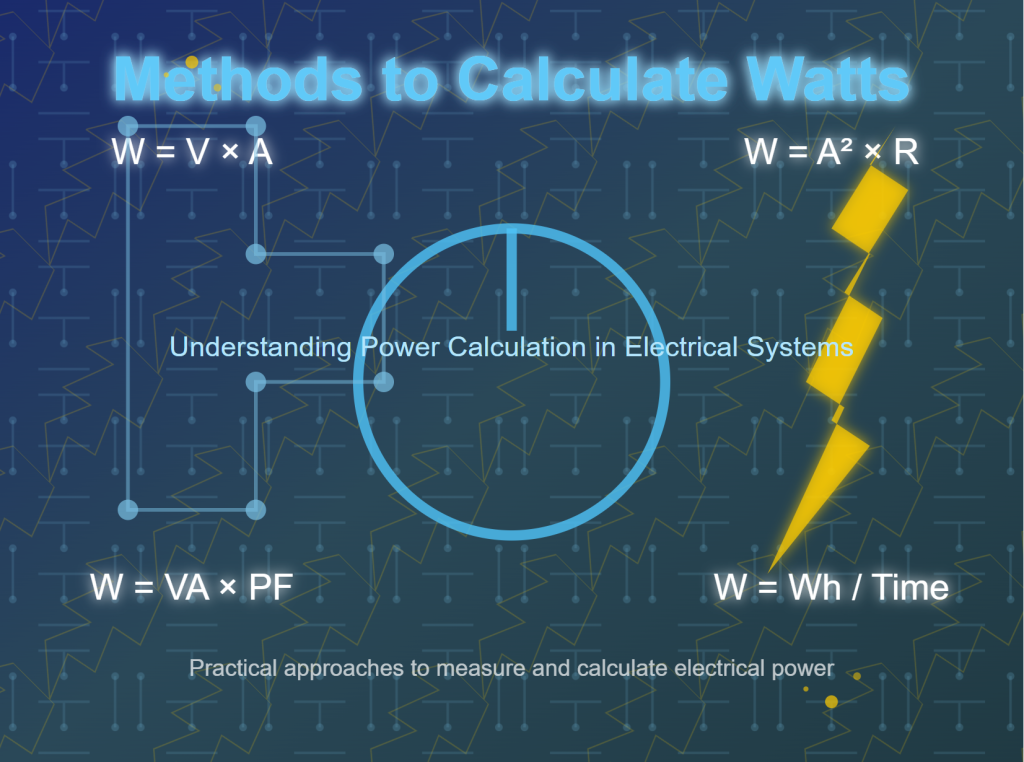
Watts = Volts × Amps
This relationship can be understood through the following table:
| Electrical Unit | What It Measures | Water Analogy |
|---|---|---|
| Volts (V) | Electrical pressure that drives the flow | Water pressure in a pipe |
| Amps (A) | Amount of electrical current flowing | Volume of water flowing through the pipe |
| Watts (W) | Power – the rate of energy transfer | Total water delivery capability (pressure × volume) |
In practical terms, an appliance drawing 5 amps at 120 volts consumes 600 watts of power. This formula forms the foundation for most wattage calculations and helps us understand why devices with similar functions might have different energy requirements.
Watt vs. Watt-Hour: What’s the Difference?
When dealing with electricity, it’s easy to confuse watts (W) and watt-hours (Wh) — but they’re not the same. Understanding the difference helps you measure power use more accurately and manage energy better.
What is a Watt-Hour?
A watt-hour (Wh) is a unit of energy that measures the total amount of electricity consumed over a specific period. Unlike watts, which measure instantaneous power, watt-hours tell us about cumulative energy usage.
Energy vs. Power: The Fundamental Difference
| Aspect | Watts (W) | Watt-Hours (Wh) |
|---|---|---|
| Measures | Power (rate of energy use) | Energy (total used over time) |
| Time factor | Instantaneous measurement | Includes time component |
| Unit type | Rate unit | Quantity unit |
| Billing relevance | Determines capacity needed | What your utility company charges for |
For example, if a 60-watt light bulb operates for 10 hours, it consumes 600 watt-hours (60W × 10h = 600Wh) of energy. This measurement tells us the total energy used, not just how quickly it was using energy at any moment.
Comparing Watts vs. Watt-Hours
The Speed vs. Distance Analogy
The relationship between watts and watt-hours can be understood through a simple transportation analogy:
- Watts are like speed (miles per hour) – how fast energy is being used at a moment
- Watt-hours are like distance (total miles) – how much energy has been used in total
When to use which unit:
- Use watts when:
- Sizing electrical systems (circuit breakers, fuses)
- Comparing the power consumption rate of devices
- Determining if your electrical panel can handle a new appliance
- Use watt-hours when:
- Calculating your electricity bill
- Determining battery capacity needs
- Planning energy usage over time
- Estimating long-term energy consumption costs
5 Methods to Calculate Watts
Calculating watts is essential for understanding how much power an electrical device uses. Depending on what information you have, you can use different formulas or tools. Below are five practical methods to calculate watts, with examples and use cases.
Method 1: Using Voltage and Current
The most common and straightforward method to calculate watts uses the relationship between voltage and current:
Formula: Watts (W) = Volts (V) × Amps (A)
Example calculation:
- A device operating at 12 volts drawing 5 amps
- W = 12V × 5A = 60 watts
When to use this method:
- When voltage and current measurements are readily available
- Ideal for DC circuits and basic AC circuits
- When calculating power requirements for new installations
Method 2: Using Resistance and Current
This method is particularly useful when working with resistive components:
Formula: Watts (W) = Amps (A)² × Resistance (Ω)
Explanation of resistance: Resistance, measured in ohms (Ω), represents how much a component opposes the flow of electrical current.
Example calculation:
- Current flowing through a 10-ohm resistor is 2 amps
- W = (2A)² × 10Ω = 4 × 10 = 40 watts
When to use this method:
- When working with resistive heating elements
- In circuits where resistance values are known
- When direct voltage measurement is difficult
Method 3: Using Power Factor and Apparent Power
For AC circuits, especially with inductive or capacitive loads:
Formula: Watts (W) = Apparent Power (VA) × Power Factor (PF)
| Term | Definition | Range |
|---|---|---|
| Apparent Power | Total power flowing in an AC circuit (VA) | Measured in volt-amperes |
| Power Factor | Ratio of real power to apparent power | 0 to 1 (1 being ideal) |
Example calculation:
- Device with apparent power of 1000 VA and power factor of 0.8
- W = 1000 VA × 0.8 = 800 watts
When to use this method:
- AC circuits with motors, transformers, or capacitors
- Industrial equipment where power factor is specified
- When calculating actual power consumption for billing
Method 4: Using Energy Consumption and Time
When you know the total energy used over a period:
Formula: Watts (W) = Watt-hours (Wh) / Time (hours)
Example calculation:
- Device consuming 200 watt-hours over 4 hours
- W = 200 Wh ÷ 4h = 50 watts
When to use this method:
- Analyzing historical energy consumption
- Determining average power draw for variable load devices
- Estimating power requirements based on energy bills
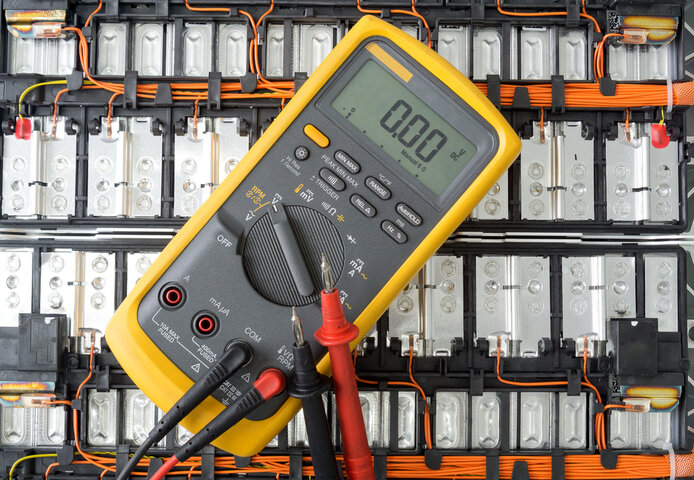
Method 5: Using a Wattmeter
The most direct and accurate method for measuring power consumption:
What is a wattmeter?
A wattmeter is a specialized instrument that directly measures electrical power consumption of a device or circuit in real-time.
Benefits of using a wattmeter:
- Provides accurate real-time power measurements
- Accounts for all power factors and circuit conditions
- No calculations required
- Can track varying power consumption
How to use a wattmeter:
- Insert the wattmeter between the power source and device
- Ensure proper voltage range selection
- Turn on the device being measured
- Read the display for direct wattage consumption
Choosing the right method depends on what measurements you have available and the specific electrical system you’re working with.
Why Knowing Wattage Matters
Understanding wattage isn’t just for electricians—it plays a vital role in saving energy, sizing batteries, protecting circuits, and keeping your devices safe. Below are the key reasons why knowing how to calculate watts is important.
Energy Efficiency
Calculating the wattage of your devices and appliances empowers you to make smarter energy decisions:
- Lower electricity bills: By identifying high-wattage devices, you can prioritize which ones to upgrade or use less frequently
- Comparative shopping: Compare the actual operating costs of appliances based on their wattage
- ROI calculations: Determine payback periods for energy-efficient upgrades
For example, replacing ten 100-watt incandescent bulbs with 23-watt LED equivalents saves 770 watts. At 5 hours of daily use and $0.10/kWh, this translates to approximately $140 annual savings—showing how wattage calculations directly impact your bottom line.
Battery Sizing
For off-grid systems, RVs, or emergency power supplies, proper battery sizing is crucial:
Converting battery capacity to usable power:
- Identify your device’s wattage requirements
- Determine how many hours of operation you need
- Calculate total watt-hours required
- Convert amp-hours (Ah) to watt-hours using: Wh = Ah × Voltage
| Battery Voltage | Battery Capacity (Ah) | Available Power (Wh) |
|---|---|---|
| 12V | 100Ah | 1,200Wh |
| 24V | 100Ah | 2,400Wh |
| 48V | 100Ah | 4,800Wh |
Circuit Protection
Understanding wattage is essential for proper electrical safety:
Safety Principle: Circuit breakers and fuses must be rated higher than the maximum wattage of connected devices.
To calculate appropriate circuit protection:
- Determine the maximum wattage of all devices on the circuit
- Convert to amps using: Amps = Watts ÷ Volts
- Choose a breaker/fuse rated slightly above this value (typically next standard size up)
Equipment Safety
Incorrect power calculations can lead to equipment damage or failure:
- Underpowering: Causes devices to malfunction or operate inefficiently
- Overpowering: Risks overheating, component failure, or even fire hazards
- Voltage mismatch: Connecting equipment to the wrong voltage can permanently damage expensive devices
Specialized Calculations: Estimating Wattage for Heating Applications
When heating materials like metal or liquids, you can estimate the required wattage using a simple formula. This helps in choosing the right heaters or designing efficient thermal systems.
Heating Solids and Liquids
The wattage requirements for heating different materials can be quickly estimated using this practical formula:
W = Material Coefficient × Lbs × (Target Temp – Start Temp) / Time
Where:
- W = Wattage required (watts)
- Material Coefficient = A material-specific value (see table below)
- Lbs = Weight of material in pounds
- Target Temp – Start Temp = Temperature difference in Fahrenheit
- Time = Desired heating time in hours
Material Coefficient Reference Table:
| Material | Coefficient |
|---|---|
| Stainless Steel | 0.050 |
| Aluminum | 0.100 |
| Copper | 0.042 |
| Brass | 0.040 |
| Iron | 0.052 |
| Water | 0.420 |
| Oil | 0.180 |
Note: The formula includes approximately 40% extra wattage above the theoretical minimum requirement. This built-in safety margin accounts for heat losses to the environment, ensuring your system reaches target temperature within the specified timeframe despite real-world inefficiencies.
Example 1: Heating a Steel Platen
Let’s calculate the wattage needed to heat a 24-pound stainless steel platen from room temperature (72°F) to 300°F in 30 minutes:
- Identify the variables:
- Material Coefficient (stainless steel) = 0.050
- Weight = 24 lbs
- Temperature difference = 300°F – 72°F = 228°F
- Time = 0.5 hours
- Apply the formula: W = 0.050 × 24 × 228 / 0.5 = 547.2 watts
- Round up for safety: 550-600 watts recommended
Example 2: Heating a Water-Filled Aluminum Trough
For a system with multiple materials, calculate each component separately:
- For the 50-pound aluminum trough (40°F to 70°F in 1 hour): W(trough) = 0.100 × 50 × (70-40) / 1 = 150 watts
- For the 80 pounds of water inside: W(water) = 0.420 × 80 × (70-40) / 1 = 1,008 watts
- Total wattage required: W(total) = 150 + 1,008 = 1,158 watts
- Recommended with safety margin: 1,200 watts
This specialized calculation method provides a reliable estimate for sizing heating elements in various industrial applications.
Key Formulas Cheat Sheet
When calculating electrical power in watts, having the right formula at your fingertips can save time and ensure accuracy. This comprehensive cheat sheet provides the essential formulas for various electrical calculations, whether you’re working with DC circuits, AC power systems, or analyzing energy consumption.
| Formula | What It Calculates | When To Use |
|---|---|---|
| W = V × A | Power from voltage and current | Basic circuits, most common scenario |
| W = A² × R | Power from current and resistance | Resistive loads, no voltage measurement |
| W = VA × PF | Real power from apparent power | AC circuits with reactive components |
| W = Wh / Time | Average power from energy used | Energy consumption analysis |
| A = W / V | Current from power and voltage | Circuit design, wire sizing |
| V = W / A | Voltage from power and current | Voltage drop calculations |
Power Calculation Examples
W = V × A (Watts = Volts × Amps)
A laptop charger operating at 19V and drawing 3.42A: 19V × 3.42A = 65W
W = A² × R (Watts = Amps² × Resistance)
A 2A current through a 5Ω heating element: 2A² × 5Ω = 4 × 5 = 20W
W = VA × PF (Watts = Volt-Amps × Power Factor)
A motor with 1000VA apparent power and 0.8 power factor: 1000VA × 0.8 = 800W
W = Wh / Time (Watts = Watt-hours ÷ Time)
A device consuming 450Wh over 3 hours: 450Wh ÷ 3h = 150W
A = W / V (Amps = Watts ÷ Volts)
A 1200W appliance running at 120V: 1200W ÷ 120V = 10A
V = W / A (Volts = Watts ÷ Amps)
A 2400W device drawing 20A: 2400W ÷ 20A = 120V
Quick Decision Guide
Choose your formula based on what you know:
- Know voltage and current? → Use W = V × A
- Know resistance and current? → Use W = A² × R
- Working with AC power? → Use W = VA × PF
- Know total energy used? → Use W = Wh / Time
- Need to determine wire gauge? → Use A = W / V
- Need to check voltage requirements? → Use V = W / A
Final Words
You’ve learned 5 reliable methods to calculate watts, from formulas to tools like wattmeters.
Knowing watts helps you save energy and protect your devices.
Use this knowledge when choosing appliances, sizing batteries, or planning circuits.
Start applying it today—smart energy use begins with understanding power.